

Disruption, Ethics, Policy & AI Adoption in Universities Dominate Discussions at Mastersoft’s AI Conclave
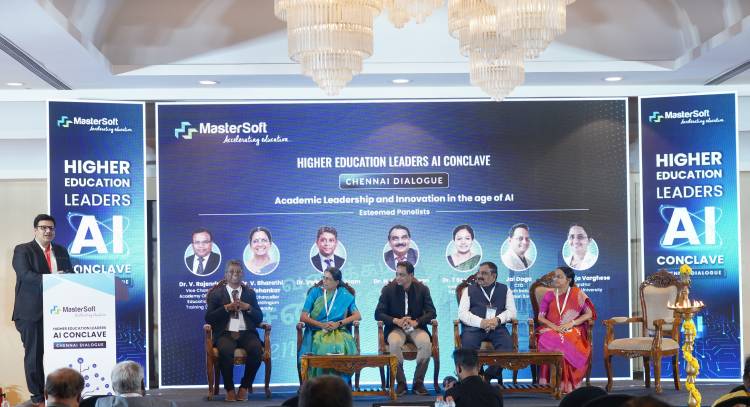
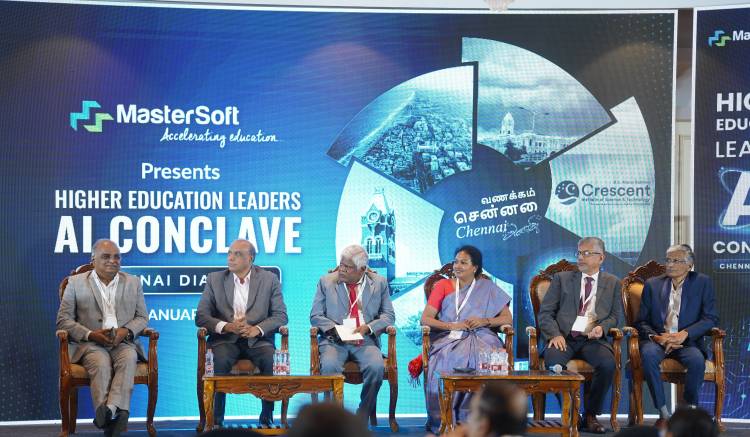
In a pivotal gathering that signals the next frontier of India’s higher education transformation, Mastersoft ERP Solutions Pvt Ltd successfully hosted the Higher Education Leaders AI Conclave – Chennai Dialogue 2026, bringing together some of the most influential voices in university leadership, governance and educational innovation.
With Artificial Intelligence rapidly reshaping academic ecosystems, the conclave served as a timely platform to deliberate on a defining question for India’s universities:
How can institutions harness AI responsibly while safeguarding ethics, policy frameworks, and student-centric outcomes?
The Chennai Dialogue emerged as an important milestone, reinforcing that while AI will redefine education delivery and governance, its adoption must be anchored in accountability, transparency, and institutional readiness.
Mastersoft Positions Itself at the Forefront of AI-Enabled Education Governance
Delivering the welcome address, Shri Sham Somani, Founder Managing Director, Mastersoft, highlighted that the world is fast entering the era of Agentic AI, where systems will no longer remain limited to assistance but will actively execute institutional workflows.
“Menus will disappear in the coming years. There will be one search bar, and AI will do the rest — configuring ERP systems, building question banks, and supporting teachers. But the key is to use AI responsibly,” he noted, reaffirming Mastersoft’s commitment to ethical and actionable innovation.
Mastersoft’s leadership at the conclave was strongly anchored in its vision of enabling universities not merely through automation, but through governance-ready AI systems that evolve with regulatory demands, institutional needs and learner expectations.
Mastersoft President Highlights Compliance, Security and Global Standards for AI Adoption
Introducing Mastersoft’s journey and impact, Mr. Gaurav Somani, CEO, Co-founder, Mastersoft, emphasised that AI transformation in education must be built on strong foundations of:
Data privacy, Cybersecurity readiness, GDPR alignment, ISO compliance, Regulatory integration
“In an age where education institutions are increasingly vulnerable to cyber and privacy risks, governance cannot be an afterthought,” he stated.
“Even one European Union applicant on your portal makes GDPR applicable. Institutions must prepare for AI adoption with global compliance standards,” he cautioned, underscoring the urgency for structured institutional preparedness.
Ethics & Policy Take Centre Stage: AI Needs Institutional Frameworks
A powerful and recurring theme across the conclave was the urgent requirement for AI governance policies at the institutional level.
Dr. Vaibhav Mishra stressed:
“Every institute must have strong AI governance and ethical policies. Without integrity frameworks, plagiarism, misuse of data, and academic disputes will multiply.”
Speakers agreed that AI adoption must not outpace ethical safeguards, especially in sensitive areas such as research integrity, student assessment, admissions, and academic evaluation.
Disruption, Innovation and Governance in the Age of AI
The conclave featured two engaging and forward-looking panel discussions, both moderated by Mr. Gurudev Somani – CEO & Co-founder, Mastersoft, reflecting the evolving priorities of Indian higher education in an AI-driven era. Conversations around Academic Leadership and Innovation in the Age of AI brought together eminent academic voices including Vaibhav Meshram, Dr. V. Bharati Harishankaran, Dr. N. Malmurugan, and Dr. Sheeja Varghese. The session explored how universities must strengthen governance models, modernise pedagogy, and build institutional agility as AI increasingly becomes embedded in academic decision-making. Speakers emphasised that innovation in education cannot be limited to technology adoption alone, but must be anchored in ethical responsibility, leadership readiness, and long-term institutional vision.
Complementing this, discussions focused on Building Student-Centric Journeys in Higher Education featured thought leaders such as Dr. Paul Wilson, Dr. K. Sridhar, Dr. S. Mohan, Dr. Shashi Prabha, and Dr. Subhaya Bharathi. The dialogue highlighted how the future university experience must be redesigned around learners — from personalised academic pathways and digitally enabled services to AI-supported mentorship and holistic campus ecosystems. Panelists noted that institutions that place students at the centre of transformation, while leveraging AI for engagement and outcomes, will define the next generation of higher education excellence.
The session struck at the heart of India’s higher education crossroads:
As the conclave drew to a close, the event culminated with two deeply insightful and forward-looking leadership sessions that resonated strongly with the academic community present. Dr. T.P. Sasikumar delivered a compelling address on “Reimagining Institutions: The Journey to Universityhood,” reflecting on how institutions must evolve with clarity of vision, governance maturity, and academic ambition in the age of AI-led disruption. This was followed by Dr. N. Jayasankaran, who spoke on “Leadership Capacity to Capability – The Missing Link in Accreditation & Rankings,” underlining that sustainable excellence in higher education will depend not only on infrastructure or compliance, but on visionary leadership, institutional culture, and the ability to translate capacity into measurable outcomes. Together, these sessions provided a powerful and fitting conclusion to Mastersoft’s Chennai Dialogue, reinforcing the message that the future of higher education lies at the intersection of ethics, governance, and institutional transformation.
AI will reshape universities — but governance, ethics, and leadership will decide the direction of that reshaping.